

Forget the old idea of a gamer stuck in a dark room. Today’s esports courses focus on more than just playing games. They teach you about the huge industry that has grown around it. It’s like moving from playing the game to running the team, analyzing everything from strategy to money.
So, what do these programs teach? They help you go from being a fan to understanding the game’s business side. You learn about salary caps, franchise models, and the whole ecosystem of professional gaming.
For instance, top esports online courses don’t just teach you to play. They teach you to think like a strategist. You’ll study the connections between developers, teams, players, and media rights. You’ll also learn about managing teams and making money from your passion.
This isn’t just theory. It’s a real way to get into the competitive gaming world. If you want to go from watching to leading, a structured esports training course is your guide. You’ll learn about contracts, sponsorships, and the global esports market. This way, you become a key player in the industry’s future.
Skill-based vs. theory-based learning in esports education
The journey to becoming an esports pro starts with a big choice. You can dive into the hands-on world of game creation or learn the strategic side of the industry. It’s not just about playing games; it’s about finding your place in a huge market. Do you want to create the game, or lead the team that plays it?
Choosing between skill-based and theory-based learning shapes your future. One path lets you code the next big game. The other lets you manage the team that plays it. Both are key, but they require different skills and mindsets.
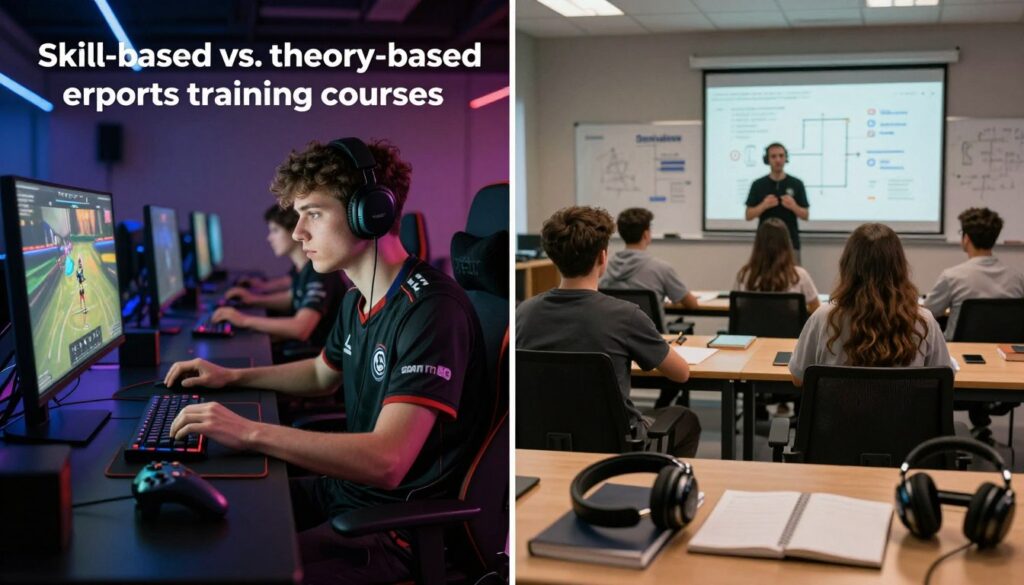
The Controller in Your Hand vs. The Playbook in Your Head
It’s like the difference between a mechanic and a pit crew chief. One works with the engine, coding and designing. The other calls the shots, managing the team and strategy. Both are vital for success, but they speak different languages.
The mechanic talks in code and design. The strategist talks in strategy and business. They both have their own roles in winning the game.
Mechanical Mastery Courses
This path is for those who want to build the game. It’s for the creators who ask “how?”
Courses like Game Design and Development with Unity or Unreal Engine FPS Development fall into this category. They focus on the technical side, like coding and physics. You learn the game engine’s language.
The theory-based path is for the strategist. Here, you find esports online courses like the Esports Management Specialization. This path is about managing the team, securing sponsors, and winning the season. It’s about the strategy, not just the game.
| Attribute | Skill-Based Learning (The “How”) | Theory-Based Learning (The “Why” & “Who”) |
|---|---|---|
| Primary Focus | Hands-on, technical skill development. | Strategic, managerial, and business acumen. |
| Typical Courses | Game Development (Unity/Unreal), 3D Modeling, C++ Programming. | Esports Management, Marketing, Sports Law, Team Operations. |
| Core Question | How do we build this? | Why does this succeed as a business? |
| End Goal | Developer, Game Designer, Level Designer. | Team Manager, Brand Manager, League Commissioner. |
| Analogy | The engineer building the race car. | The team principal running the race strategy. |
The table shows a big choice in your career. The left side is for those who love to tinker and code. The right side is for those who enjoy planning and strategy.
So, which path do you choose? Do you enjoy the instant feedback of coding, or the long-term satisfaction of building a brand? The esports training courses for builders and strategists are different, but both are vital. One teaches you to create the game. The other teaches you to market it.
Platform power play: Where you learn matters as much as what you learn
Forget console wars; the real battle in esports education is between academia and the industry. Your choice of classroom—a university-affiliated platform or a studio-led academy—changes your learning style. It also affects the value of your credential.
University-Backed vs. Industry-Led Platforms
Choosing between a university-affiliated esports online course and an industry-led bootcamp is like choosing between a Swiss Army knife and a scalpel. One offers a versatile, theory-rich education; the other is a precision tool designed for a specific job.
University-backed platforms, like those on Coursera or edX, partner with institutions like UC Irvine or CalArts. You’re not just learning game design; you’re learning it with the academic rigor of a university extension. The credential you earn—a verified certificate from a known institution—carries the weight of academic tradition. It’s a signal to employers that you understand the ‘why’ behind the ‘how.’
Conversely, an industry-led esports training course from a company like Epic Games or a specialized academy is a direct pipeline to the tools and techniques used on the job today. It’s less about the theory of game economies and more about which specific API call in Unreal Engine 5 will make your particle effects 20% more efficient.
The Credential Conundrum: University Extensions vs. Corporate Academies
This is where the rubber meets the road in your career. A university-backed certificate says, “I understand the academic and theoretical framework of this field.” It’s a broad-spectrum credential that signals a well-rounded, analytical mind to a wide range of employers. The corporate or studio-specific certification, on the other hand, screams, “I can do the job you need done, right now, on the tools you use.” An Epic Games certification doesn’t just say you know Unreal Engine; it says you know it to their exacting, industry-standard specifications.
The table below cuts through the marketing to show you the real trade-offs.
| Feature | University-Backed (e.g., Coursera, edX) | Industry-Led (e.g., Epic Dev. Network, Studio Academies) |
|---|---|---|
| Credential Focus | Academic, theory-grounded certificate from a known institution. | Industry-recognized, tool-specific certification (e.g., Epic Games, Unity). |
| Curriculum Focus | Broader theory, history, and foundational principles. | Hands-on, project-based, using current industry tools and pipelines. |
| Best For | Those seeking a career in management, academia, or a broad strategic role. | Those aiming for a specific, hands-on technical or production role in a studio. |
| Time to Value | Longer-term; builds a deep, transferable knowledge base. | Faster, direct path to job-ready skills for a specific role. |

So, which path is right? If you see yourself as a future producer, strategist, or academic, the university-backed path provides the foundational language and theory to lead. If your dream is to be in the engine room, coding the next hit battle royale, the industry-led esports training course is your express lane. The best path often involves both: using a university-backed course for foundational theory and a specialized industry course for the latest tool mastery. For a prime example of theory and practice merging for social impact, explore the resources at Games for Change, where education and applied learning meet.
The paper chase: When a certificate is more than a participation trophy
In esports, winning isn’t just about the score. It’s about the stats, VODs, and proof of skill. The same goes for esports education. Watching tutorials on YouTube is great, but a digital badge can make your resume stand out. It can mean the difference between a job offer and just a highlight reel.
Let’s get real. What’s a digital certificate really worth in a world that values skill and performance?
The Value of a Verified Certificate vs. “I Watched the Videos”
Watching videos is easy. But a Verified Certificate shows you’ve been tested and verified. It proves you’ve done more than just watch. You’ve completed projects, passed quizzes, and met a university’s standards.
A generic “Certificate of Completion” just says you showed up. But a verified certificate shows you were tested and passed. In the world of esports management and team operations, this is a big deal. It shows you’ve learned from a structured, university-level curriculum, not just YouTube tutorials.
Skill-Based Badges vs. Academic Credit
Skill-based badges from platforms like Coursera or edX prove you can do things. They show you can build game levels, analyze team data, or manage social media campaigns. They’re all about practical, demonstrable skills.
On the other hand, academic credit is about formal recognition. It’s like the UC Irvine Coursera specialization or university-credit micro-credentials. This isn’t just a badge; it’s a formal recognition that often translates into actual college credit. It’s the difference between a skill badge and a transcript entry. For a corporate job in a traditional esports organization, the weight of academic credit from a known institution can open doors that a portfolio link alone might not.
So, which is the golden ticket? The answer depends on your goals. If you’re aiming for a corporate gig at a major esports franchise or a tournament organizer, a verified, credit-bearing certificate from a known platform carries weight. It’s a shared language with HR. If you’re gunning for a role at an indie studio or as a freelance caster, that skill-based badge and the killer portfolio piece you built for it will speak volumes. The smart play? Often, it’s a combination: the verified certificate for the resume, and the skill badge for the portfolio. In the high-stakes game of esports careers, you don’t just want to play—you want the right gear for the match.
The due diligence decoder: How to vet an esports course
Choosing the right esports online courses is not just about the name. It’s about the details in the syllabus. Before you sign up, think like a scout, not a fan.
The Curriculum Autopsy: Beyond the Sales Page
Don’t just look at the module titles. A top esports training course is all about the projects. Does it have a capstone project, like building a tournament budget or a brand plan? That’s a good sign.
Vague promises of “mastering the esports industry” are bad. You want specific, hands-on projects. These are the ones that get you hired, not just a piece of paper.
The Instructor Litmus Test
Who’s teaching? A professor who hasn’t played esports in years is different from an active pro. The best esports training courses are taught by those who are in the game, like Stephane Muller from the proven path of a pro player.
Don’t just look at their bio. Do they work in esports now? Have they negotiated a pro contract or run a major event? Their experience is your education.
The best course teaches you the game and the business. It goes from theory to a tactical plan. It gives you the tools to analyze, strategize, and execute. It’s the difference between watching the game and learning to play it.