

Remember trying to convince your parents that Super Mario was a profound lesson in problem-solving? What if we told you that today’s classrooms are starting to agree?
Forget the old debate about screens and controllers. We’re entering an era where the strategic depth of a team fight or a perfectly executed in-game economy is the new curriculum. This isn’t about playing more; it’s about playing with purpose. We’re talking about a new kind of classroom where the syllabus includes aim training, resource management, and the delicate art of the flank.
It’s not just about quick reflexes. It’s a cognitive boot camp. We’re building skills in strategic foresight, emotional regulation under pressure, and split-second decision-making. This is where the modern, structured approach to esports education thrives, transforming play into a powerful pedagogical tool.
This structured approach is already taking root in forward-thinking institutions. As explored in our analysis of esports in schools, these programs are proving that the path to victory in a game often mirrors the path to success in the classroom and beyond.
So, how do we move from the living room couch to a legitimate, skill-building curriculum? It begins with the right game, the right mindset, and a community that gets it.
Skill development stages
Think of leveling up in an esports title. You don’t start with a legendary skin and a god-tier K/D ratio. You start with the basics, fumbling with the controls. The journey from enthusiastic button-masher to a player with precise, predictive game sense isn’t magic—it’s a structured climb. This is the core of a practical esports education: understanding that mastery is a deliberate, stage-by-stage process, not a random power-up.
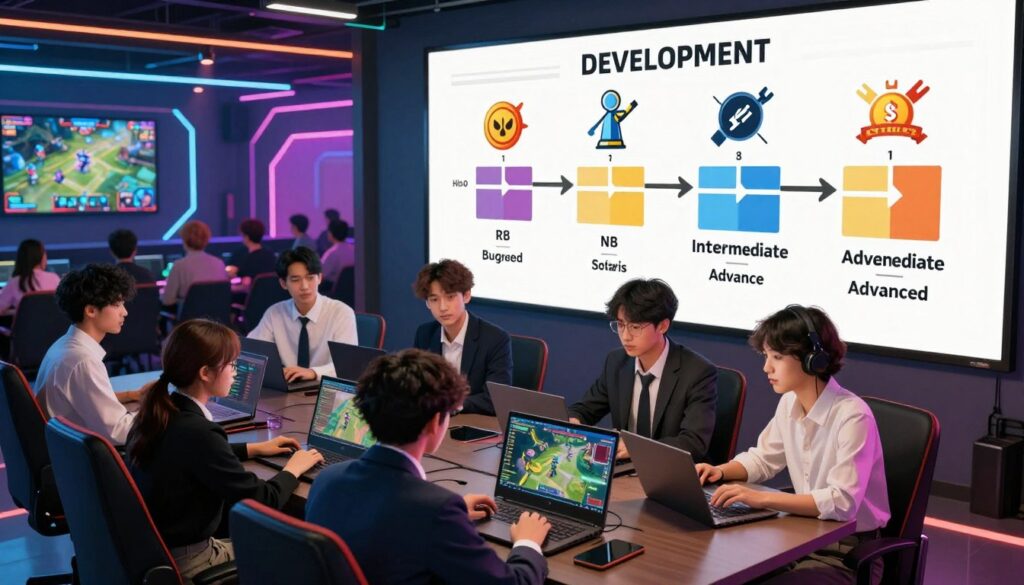
Let’s break down the three distinct stages of skill development in competitive gaming. Forget the destination for a moment; the journey is the curriculum.
The Apprentice: “What Do All These Buttons Do?”
This is the “conscious incompetence” phase. You’re all thumbs, and your in-game character has the survival instincts of a lemming. You’re learning the map, the controls, the absolute grammar of the game. You know you don’t know, and every match is a firehose of information. Your focus here is pure mechanical skill and basic game sense: learning to move, aim, and execute the most fundamental actions without having to think about which key is “jump.” The goal isn’t to win, but to stop feeling like a liability to your team.
The Grind: From Playing to Practicing
This is the make-or-break plateau. You know the basics, but now you must move from conscious incompetence to conscious competence. This is “The Grind.” It’s no longer just playing; it’s practicing with intent. Here’s where a systematic esports education framework separates the hobbyist from the contender. This stage is defined by deliberate practice:
- VOD Review: Watching your own gameplay (VODs) with a critical, almost masochistic, eye. Why did you die? What was your minimap awareness like? This is where you move from feeling you played badly to knowing you over-extended at the 3:15 mark.
- Aim & Mechanics Drills: This is the free-throw practice of esports. Using aim trainers or specific in-game modes to build muscle memory and consistency, turning flick shots and ability combos into second nature.
- Structured Learning: This is where formal resources become invaluable. Just as an aspiring musician studies scales, a structured program like the curriculum from Tencent’s esports education initiatives can provide the framework to analyze pro gameplay and understand macro-level strategy.
The Artisan: The Game as a Language
The final stage is unconscious competence. You’re not just reacting; you’re predicting. Your game sense is so honed you can read the meta like a bestselling novel, anticipating enemy rotations and resource timings instinctively. Your mechanics are so fluid they feel like an extension of thought. You’re not just a player in the game; you’re a conductor of its systems. This isn’t just about good aim; it’s about predictive strategy, deep meta-knowledge, and leading a team. This level of skill development is what separates a good player from a pro.
The progression isn’t a straight line; it’s a spiral. You’ll revisit fundamentals with new understanding. The key is recognizing which stage you’re in and applying the right kind of practice. It’s the difference between playing checkers and 4D chess. The table below breaks down the focus at each stage:
| Stage | Primary Focus | Key Activities | Mindset Shift |
|---|---|---|---|
| The Apprentice | Mechanical Control & Basic Rules | Learning controls, map layout, basic abilities. | “What do all these buttons do?” |
| The Grind | Deliberate Practice & Analysis | VOD review, aim training, strategy study. | “Why did I die there? How can I practice that flick shot?” |
| The Artisan | Predictive Play & Meta Mastery | Advanced macro strategy, opponent psychology, meta-analysis. | “I know what they will do before they do it.” |
This structured approach to skill development is what transforms raw talent into reliable skill. It’s the difference between just playing the game and actively studying it. For a deeper dive into structured pathways for this growth, programs focused on esports education can provide the roadmap, turning the chaotic fun of a game into a disciplined craft.
Tools and courses by level
Getting into competitive gaming without the right tools is like going to a tournament without a guide. The right esports education is tailored to your level. It helps you improve, whether you’re new or experienced.
Beginners focus on basic skills and game understanding. You don’t need complex strategies yet. Tools like Kovaak’s FPS Aim Trainer help you practice. In-game tutorials and replay functions are also key.
Intermediate players move on to more complex analysis. Tools like Blitz.gg provide real-time stats and suggestions. This phase is about studying the game, not just playing it.
At the advanced level, you dive deep into data analysis. You’re like a gaming scientist. Platforms like Mobalytics offer detailed breakdowns of your gameplay. Coaching focuses on strategy, psychology, and understanding the game’s dynamics.
Your esports education is like a tech tree in a game. You start with basics like aim and map knowledge. As you progress, you unlock more advanced skills and strategies. The right tools at the right time improve your game and mindset.
Legal and business literacy
You’re a pro at the game, but do you know the business side? Without legal and business smarts, you’re just a pawn. It’s time to level up and learn the game’s business side.
Think of your skill as your in-game character. Your legal and business knowledge is like your HUD. It shows you where the enemies are and when to watch out. Without it, you’re just guessing.
Let’s look at what you need for this raid.
1. The Fine Print is Your New Best Friend (Or Your Worst Enemy)
That long contract from an esports org or sponsor is key. It’s your rulebook for life. Every clause, from salary to streaming, is important. Not knowing these terms is like not knowing your ultimate ability.
Your in-game name and persona are your IP. When you sign a contract, you’re licensing your name and brand. A good contract protects you. A bad one can trap you.
3. Financial Literacy: From Prize Pools to Tax Pools
Prize money isn’t just yours. You need to know about taxes. That $100,000 win isn’t $100,000 in your pocket. You have to budget and understand taxes.
This isn’t just about avoiding bad deals. It’s about having control over your career. Knowing the business side helps you build a lasting career. For a guide on starting your esports career, check out our guide on the road to becoming a pro.
The most important play is understanding the contract and your worth. Building a lasting career is the ultimate goal. It’s not just about quick reflexes.
Preparing for life beyond competition
So, you’ve mastered the meta, but what’s your plan for after the games end? The real challenge isn’t the final tournament; it’s transitioning to real life. When the lights dim, the real game starts.
This is where your esports education really matters. It’s not just about playing games; it’s about building a career. Your skills in the game can lead to new paths, like coaching or content creation.
Managing your career is like managing a game. You use your experience to plan your future. Your skills in teamwork and strategy are key to success in any field.
The final boss is not just a game challenge. It’s about creating a life that continues beyond gaming. Winning is not just about tournaments; it’s about living a fulfilling life.